Showing posts with label Housekeeping. Show all posts

Tuesday, April 14, 2015

Tidy Tuesday: KonMari Method: Last Sections of the Book

Other Things To Point Out:
As you reduce, your belongings through the process of tidying, you will come to a point where you suddenly know how much is just right for you. I feel like this is very true as there is a magic level for most things. Follow your intuition with how your home should be laid out and what sort of things should be hung or not. Feng Sui is cool and all, but what works and feels right to you?

Don’t stock pile. Especially if you are a Costco Buyer. There is very little you should actually have a lot of. The fact that you own a surplus of things that you can’t bring yourself to discard doesn’t mean you are taking good care of them. In fact, it is quite the opposite.

Most importantly, believe what you heart tells you when you ask “Does this item spark joy?”

Section 4: Storing Your Things To Make Your Life Shine:
The point in deciding specific places to keep things is to designate a spot for EVERY thing. Once you learn to choose your belongings properly, you will be left only with the amount that fits perfectly in the space you currently own. When you are choosing what to keep, ask your heart; when you are choosing where to store something, ask your house.

Pursue the ultimate simplicity in storage. Don’t over think it. Make it accessible and follow the 2 Rules of storage: Store all items of the same type in the same place and don’t scatter storage space. If you live with your family, first clearly define separate storage places for each family member. This will keep stress down for the whole family as everyone needs a sanctuary. Clutter is caused by a failure to return things to where they belong. Therefore, storage should be reduce the effort needed to put things away, not the effort needed to get them out. If you are aiming for an uncluttered room, it is much more important to arrange your storage so that you can tell at a glance where everything is than to worry about details of who does what, where, and when. Remember, your house already knows where everything belongs. Keep like with the like and similar items near each other. Don’t Disperse your storage.

Do not pile things! Vertical storage is the key. Keep in mind that stacking things is very hard on the thing on the bottom. Don’t get sucked into the commercial storage items and tricks. All you need are drawers, (square) boxes, and shelves. Rather than buying something to make do for now, wait until you have completed the entire process and then take your time looking for storage items that you really like.

The best way to store bags is in another bag. Store the same type of bag with in a same type of bag. Empty your bag every day. Have a place for every item you use in your daily bag. Then every time you need a different purse or bag, you know you have the items you need. Plus, it gives you bag a break and allows it to not gain clutter.

Items that usurp floor space belong in the closet. The basic method for effective use of a closet is as follows: Off season items should be stored in the cupboard above the closet. This includes Snow Wear, Swim Suits, seasonal ornaments, etc . Regular clothes in the closet, bedding in the upper shelf of your closet. Move all your storage units into your closet.
Large items like golf clubs, suitcases, appliances or guitars can live in the closet.
Decorate your closet with your secret delights – Transform your closet into your own private space, one that gives you a thrill of pleasure.
Immediately, unpack and de tag new clothes. Don’t allow them to sit in your closet, marked as new.

For shower items, bring them in and out of the shower with you every time, wiping them down afterwards. Keep the shower much tidier.
Keep things out of the bath and the kitchen sink
Sponges: they must completely dry between uses. Put them outside on your veranda or clip they up, not next to the water faucet.
The kitchen counter is for preparing food, not storing food.

Make the top shelf of your bookcases, your personal shrine. Make this area a sacred space, a power spot of pure energy.

Don’t underestimate the noise of written materials. Take off the selling labels for things and mark them simply if needed. It will calm your home and soul. Eliminate excess visual information that doesn’t inspire joy. By doing this, you can make your space much more peaceful and comfortable.

Appreciate your possessions and gain strong allies. Put positivity into them and you will have solid items.

Section 5: The Magic of Tidying Dramatically Transforms Your Life:
At their core, the things we like do not change much over time. Putting your house in order is a great way to discover what they are. Letting go is even more important than adding. The lives of those who tidy thoroughly and completely, in a single shot, are without exception dramatically altered. One of the magical effects of tidying is confidence in your decision – making capacity. When we really delve into the reasons we can’t let something go, there are only two reasons: an attachment to the past or a fear of the future. You can face them now, face them sometime, or avoid them until the day we die. The question of what you want to own is actually the question of how you want to live your life. The fact that you don’t need to search for things is an invaluable stress reliever

Life becomes much easier once you know that things will still work out even if you are lacking something. Tidying is a celebration, a special sent off for those things that will be departing from the house, and there for I will dress accordingly. In essence, tidying ought to be the act of restoring balance among people, their possessions, and the house they live in. Tidying will make your home happy. Our living space effects your body. If you detox your home, you will be detoxing your body as well.

We amass items to satisfy a craving. Not to unlike eating or drinking in excess. When we rid ourselves of the excess and stop buying on impulse, we will stop over indulging in other ways. By surrounding yourself with things that make you happy and in turn are infused with positivity, fortune and happiness are sure to follow. If you can say without a doubt “I really like this” no matter what anyone says, and if you like yourself having it, then ignore what other people might think.

What I learned from this book as a whole:
I feel so much lighter and in control of my home now. I am feeling confident right now as we are packing up. Husband and I bonded over going through all our camera, cords, and game boys. It was nice to get through most of our things before moving because it gave me the feeling of working on something that couldn't be prepped for that much more. I am happy that this book was introduced to me and that I have been able to tell others about it. I am looking forward to the rest of my life with this mentality available to me.

Tuesday, April 7, 2015

Tidy Tuesday: Konmari Method: Category 5: Mementos

What I learned about: Category 5: Mementos and Photos 
Marie Kondo starts the section off with words of wisdom, "No matter how wonderful the things used to be, we cannot live in the past. The joy and excitement we feel here and now are the most important." It is something that is hard for us to remember as a generation that lives behind a screen. Ms Kondo suggest that by handling each sentimental item and deciding what to discard, you process your past. That could not be truer for me. She also reminds us that we should not allow our past to keep us from missing new opportunities, relationships, and adventures. if you can't let go of mementos from a certain time period, you should look at the time and come to terms with it via the possessions.

One thing she reminds of us, that we are ALL guilty of is that your belongings, all of them, belong with you. Your parents house in not a memento haven even if they keep it that way. Free the space for your parents and free your own psych about the ghosts of you past that might reside there.

Leave photos for last. Whenever you find one, put them all in the same place so that you can go through them at the same time. There is only one way to sort photos. Take all the photos out of the boxes and albums and hold each one individually. This seems labor intensive, sort of like the books section, but remember how easy it was once you got going? Ms Kondo guesstimates that with the system that she has created, most trips or events can be summed up in about 5 pictures. Not always the case, but you don't need boxes upon boxes of photos. In many cases, the prints developed afterward have already outlived their purpose.

Go through your own photos now, not when you are old. That isn’t something your children should have to go through either. Enjoy them now.

Other things to point out from the end of the chapter summation: Don’t stock pile. It will just build up and you will never be sure how much you may or may not have. The author assures the reader that this is all worth it by saying, "As you reduce, your belongings through the process of tidying, you will come to a point where you suddenly know how much is just right for you." She suggest that you follow your intuition with how your home should be laid out and where and how things should live with in it. The fact that you own a surplus of things that you can’t bring yourself to discard doesn’t mean you are taking good care of them. In fact, it is quite the opposite. If you have too much, you can't be utilizing all the items in your home and that is disrespectful to your home and to the items involved. She states with confidence and encourages the reader: Believe what you heart tells you when you ask “Does this item spark joy?”

What I learned from Category 5:
I keep all the things. THAT is what I have learned. I have gotten much better than when I was a child about what to keep and what isn't needed. I think it had to do with losing people when I was young and it never being "necessary" to not keep everything I wanted to keep. I feel like that while going through things, I was in fact being able to go through my past. I got to "put it in its place" and I was able to let go of things (and, more importantly, people). I highly suggest this exercise, but DEFINITELY do this in the order Marie Kondo instructs.


Tuesday, March 31, 2015

Tidy Tuesday: Konmari Method: Category 4: Other

What I learned about: Category 4: Komono/Other
Komono translates to small articles miscellaneous items. When I explained this category to someone I just said "Everything else that isn't Clothes, Books, Papers, Mementos, or Photos". That being said, there is a law and order to this section as well.
Marie Kondo suggests these Sub Categories in this order:
CDs/DVDs
Skin care products
Makeup
Accessories
Valuables
Electrical equipment (Digi cameras, cords etc)
House hold equipment and appliances (stationary, writing materials, sewing kits etc)
Household supplies (medicine, detergents, tissues etc)
Kitchen goods/ foods (spatulas, pots, blender etc)
Other (spare change, figurines, etc).
If you have many items relating to one type of hobby, create a single subcategory for these items (like Cosplay for me)
The author makes a good point that too many people live surrounded by things they don’t need “just because”. Only keep that which inspires happiness, not what you might someday maybe need. I understand the idea, but the granddaughter of a Depression surviving Grandparents has a hard time with that concept.

Difficult Sub Categories:
Disposables – No, they don’t spark joy by themselves. Don't stock pile them for any reason.
Gifts – Present are not “things”, but a means to convey feelings tone another. You shouldn't keep gifts if they don’t spark joy. I have gotten MUCH better at this in recent years with all the moving I have done. If you don't like it, re-gift it or donate it.
Cosmetic Samples - to be saved for Trips – First questions is: What is the shelf life? Would you use this color on your day today already? Does it spark joy? Unless you have a planned next trip, don't keep it.
Electronics packages – They are bulky and dumb. I didn't even know that people kept the pacakging until I got my Husband a BluRay Player. I can almost understand us keep some boxes since we knew we would be moving, but otherwise, I don't see why you would want/need to.
Unidentified Cords – if you don’t know what it is for, then why keep it? This is a "Duh" Situation.
Broken/not well working appliances – Seriously? No reason to keep such things. This is another "Duh" Situation. Granted we have had out broken Food Processor for 6 months with out it working, but that is because I am waiting on the replacement part.
Spare buttons – You won’t use them unless you are already a sewer. Just buy a new one when you need one,
Products from the latest (now past) health craze – If you haven’t used it yet, you won’t. Having it doesn't make you thinner.
Swag – Thanks Comic-con, I didn’t need all these rubber bracelets, flyers, posters, and such. I just do my best to NOT pick stuff up while I am around the convention and even more so, clean out my bag before I leave the convention center as there might be someone passing that trashcan lid who wants that flyer. but probably not.

How it worked out for me:
This section was hard for me. Mainly because some of these sub categories, much like paper, are not solely under my authority. I went through my CDs/DvDs, Skin Care Products, Makeup, Accessories, and Valuables easily as I know exactly what I had brought into the marriage and that Husband didn't care about my Makeup and most of my Skin Care Products.

Then suddenly I was into the world of Cords and Cameras. I went though what I brought into the relationship, but I still need to ask Husband if he is ok with ridding us of this, that, or the other.

Our "Household equipment and appliances" section is also an awkward section of the cleaning out and most of it is Husband's or is ours so I don't have authority over it.

Household supplies was pretty simple as I felt comfortable cleaning those out as well as the fact that we don't' keep much extra of such things.

Then came kitchen goods and foods. If there is any communal area of our house that I have authority over, it is this area. I went through the pantry and got rid of old things that I knew wouldn't be used. I took stock of what we have so that I can attempt to use it up before we move. We have many kitchen items. I know it is because I inherited things from family members and I was gifted many other items. If you consider the idea of "sparking joy", this whole area wins for me. I love my kitchen. That being said, it was a wonderful feeling to rid myself of cookie cutters and serving dishes I didn't think we would use again let alone WANT to use again, especially to serve our families Thanksgiving Dinner. We got rid of our Juicer because it never works well or easily and it frustrates us more than brings us joy. Otherwise, most everything was kept after I touched everything an then also readied it for moving.

The last subcategory is "other". We keep all our spare change in a coin jar so I really wasn't too concerned with our author's "other" category. I assessed what else needed to be touched that weren't mementos or photos. The only left was my Cosplay and crafting section. Crafting was easy. I got rid of half my crafting boxes and fabric I had been saving for "one day". I also got on myself and finished a few of my projects I had been wanting to do. I felt even happier now that those things were accomplished and could now be enjoyed.

Then came Cosplay. This section was hard. I have gained 20 pounds since a few of these costumes, but they still bring me joy. Then some of the "pieces" belong to my costumer friend who has a selection of wigs. I cleared out a few pieces for costumes that were never used and I have no inclination to wear in the next year, aka no joy sparked. Otherwise though, I kept the majority of them. I think what I enjoy is pretty obvious.

Until the next chapter...

Tuesday, March 24, 2015

Tidy Tuesday: Konmari Method: Category 3: Papers

What I learned about: Category 3: Papers
Ms Kondo asks you to divide your papers into 3 categories and, if it doesn't fit into a category, get rid of it. Those 3 categories are: Currently using, needed for a limited time, and keep indefinitely.
She also has papers divided into needs attention, should be saved (contractual) and should be saved (other). She says, while it is not likely, the "needs attention box" should be emptied every day if possible. A basic rule of thumb of organization, she states that all of the same type of paper must stay in the same area, no where else. One topic I was a little surprised on was for "papers that are not used often" (like insurance policies, guarantees, etc), she suggests to keep them all together and that there is no need to over categorize them. After I thought about that, I conceded that it was a logical idea as you don't need to stress about such things each being in a file folder for itself.

The author found a few types of papers rather troublesome when it came to deciding to keep or not. Here are her thoughts on each:
Lecture materials – will you actually look over the materials again?
Credit card statements – You don’t really need these. Check the statement to your records then dispose of it.
Warranties for Electrical Appliances – you don’t need the manuals. You can normally find them online anyway. Keep all warranties in a single file folder. You don’t need to over categorize as these items are used once a year at most.
Greeting cards – these don’t need to be kept unless they spark joy. You have received it so it has fulfilled it’s purpose.
Used check books – same as the credit card statements
Pay Stubs – same as credit card statements

My reactions: 
I didn't have as much "success" with segment as I had with books and clothes. There is an obvious reason for that: I don't handle the papers in this house. I hand my paycheck (with stub) to Husband as he handles that finances. So the majority of the "papers" would be in his possession. I already went though my "lecture materials" and college stuff a couple years ago and got rid of all of it. The only "papers" for me to go through are really just the warranties/manuals section and greeting cards. Greeting cards quickly end up in the "Mementos" section for me so I won't be touching those boxes even for awhile. So I went though the binder o' warranties and got rid of the manuals and and such we no longer (or ever) needed. I am a list maker, so I made a very obvious place I would be keeping my lists (a currently using piece of paper) and work off them from that location.

Although I have a surplus of cards in my mementos box (my Daddy sends a lot of them), I have been good about greeting cards I have received since reading the book. Husband even made me a HUGE valentine day card that I enjoyed for a week or two and then allowed myself to get rid of it.


So this section wasn't a huge sky opening up and a beam of light striking me as I look up in awe. It was a section that I look forward to helping my Husband with when he reads the book though.


Tuesday, March 17, 2015

Tidy Tuesday: Konmari Method: Category 2: Books

Again, I started this part of the project with the thought that I might get rid of, like 5 books.

Again, I am astounded by the volume (get it?...literature humor) of things that I would happily part with at this time. As I bagged up the books that I will be getting rid of, I realized I was saving us about 2-3 boxes of heavy lifting and it invigorated me to get going on the other categories!

Y'all! Read this book!


The only time piles are ok!
Books to be rid of


Books to be kept
Here is what I took from the "Books" portion of Section 3:

She suggests that if you have LOT of book that you should divide the books in Sub Categories: General, Practical, Visual, and Magazines. Then go through them in that order. I no longer own tons of books as I have learned that Library are the greatest.That being said, I had a decent few boxes worth of books for the day we move. That being said, I didn't divide into subcategories. She reminds you to pull all the books out just like your clothes and see if it gives you pleasure when you touch it. She specifies that you shouldn't open it to skim or start to read it…Guess what? I did just that on the second book I picked up. *Shakes Head* I recovered and only fell prey to such a think one other time.

She encourages you to ask these sort of questions as well as "Does it spark joy?":
Will you really reread it? Have you read it yet? What books have you reread? Compare and be aware that you probably won’t reread it unless you are an exceptional reader. I found, while asking these questions, that I have no desire to read the Alexander McCall Smith books I have been lugging around for 9 year nor that I will actually reread the Clan of the Cave Bear Series. I did recognize that fantasy based or historical fiction books will get reread by me as well as certain volumes of poetry and plays I own. You learn something new everyday. She instructs you to keep in mind that "sometime" comes never. She goes on to suggest that the first moment you encounter a book is the best time to read it and reminds you can buy or borrow it again someday.

Good, sound advice.


Tuesday, March 10, 2015

Tidy Tuesday: Konmari Method: Category 1: Clothes

My reaction after going through my clothes:

Y'all, this book. You should read it. 

Look at all those bags with the book that made it happen!

So I started this thinking that I had gotten rid of most everything I would be getting rid of. I had already donated 5 bags of clothes and things to the local Charity shop. The Month of January had been a clean out of my clothes and I was feeling pretty confident on this topic. Then this book came into my possession. And, boy howdy, was I wrong.

Before: Closet Left
Before: Closet  Right
Before: Full Drawers: Squished Tight.
Before: Full Drawers: Squished sooooooooooo tight!

Before: Full Drawers: Squished Tight with all the clothes!
Like I said, I have gotten rid of QUITE a bit of clothing over this month already. Marie Kondo, the creator of the the "KonMari" method (it is her name, get it?), sounds more like a life coach than some sort of guru on top of a mystical mountain. This isn't Feng Shui or anything, this is a process that she figured out over the course of her life as a "Professional Tidier" or organizer as we might know it as here in the States. She even says that while this method is not Feng Shui, it is should be done so that you can then Feng Shui your home as you have the space to move things around.

I sorta rolled my eyes when Jessy suggested this book to me, but she and our friend Sarah were raving about it so I gave it a chance. All I can say is yowzer now. I have changed the face of my closet and feel so much better about all of it. I have been able to keep it looking this nice since I "Konmari"'d my clothes, too! THAT is the biggest thing that has impressed me about it.

Here are the numbers:

Tops (including PJs): Started with 117, Got rid of 31, Keeping 86
Bottoms (including PJs and leggings): Started with 86, Got rid of 34, Keeping 52
Dresses: Started with 73, Got rid of 23, Keeping 50
Hung clothes: (jackets and coats): Started with 13, Got rid of  3, Keeping 10
Socks: Started with 25, Got rid of  9, Keeping 16
Underwear: Started with 21, Got rid of 9, Keeping 12
Bags (including suitcases and grocery): Started with 16, Got rid of 4, Keeping 12
Accessories (belts and scarves): Started with 26, Got rid of 6, Keeping 20
Specific Events Clothes (Swimsuits, Snow, Formals, etc): Started with 15, Got rid of 4, Keeping 11
Shoes (including boots, flip flops, slippers: Started with 31, Got rid of 2, Keeping 29

Most importantly: 62 hangers have been liberated. and 1 whole drawer in my dresser.

Also, I can now easily fit my sewing machine in my closet as well as my suitcase of bags which previously had been in my Husband's closet.

ALL THE CLOTHES
A CLOTHESPLOSION


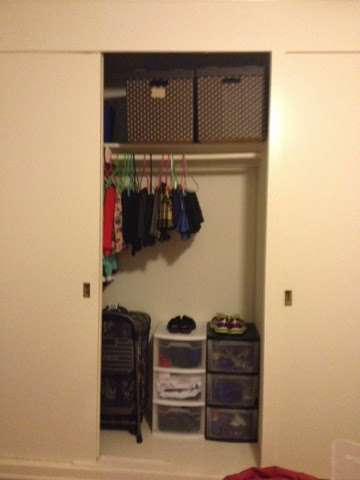
After: Closet Left
After: Closet Right

And then there is my dresser: the clothes can BREATHE now!

PJ Shirts and Night Gowns

PJ Bottoms

All My Tee Shirts!

Tank Tops and Jeans

Shorts and pants!
This method has totally changed my closet and how I view the area as my sacred space, not just storage. While I don't "Thank" each item at the end of each day, I find that replacing it in it's right place is a ceremony and a sign of respect to the item.


Here are some notes from the Clothes portion of Section 3:
The Author insists that you do clothes in this order:
Clothes Sub Categories: Tops, Bottoms, Dresses, Hung clothes – jackets and coats, Socks,
Underwear, Bags, Accessories, Specific events clothes, and Shoes

This includes EVERYTHING you have in the category. She suggests you start wiht your off season clothes of each category first and ask "will this be the first thing I want to wear when the temperature is correct for it?" or "Does it spark joy?". She warns against the “downgrade to lounge wear” pot hole that many of us fall into. If it doesn’t inspire joy, there is NO reason to try and “relax in it” at home. She states quite boldly that what you wear in the house, impacts your self image outside of it. She goes on to explain why folding is like the super duperest best thing ever and now that I have tried it, I couldn't agree more. The trick is folding to stand up, not Gap Store it flat. Also, the more you handle your clothes, the less likely you are to "forget" about items. She suggests that folding clothes can be a meditation, not a chore, and that you should "only hang the willing". Arrange your clothes in the closet so that they rise to the right, which I did, as it gives a relaxing feeling, which surprisingly, it does. Even when the door is closed, you will feel fresh and rejuvenated. The one thing she said that I felt guilty that I didn't see it earlier is the thought process of not balling up socks or stockings, Give them peace and rest while they are in your drawer and then the elastic won't give out as quickly either. In you closet and drawers, don’t over categorize your clothes, only warmer/heavy to the cooler/lightest.

Next up will be Books!

Tuesday, March 3, 2015

Tidy Tuesday: Konmari Method: Overview of the First 3 Sections of the Book

So, I was lent a book last month about "tidying". 

While I thought, "gee... I am a relatively organized person and I have made LEAPS and BOUNDS since I was in High school...that doesn't mean that this book won't benefit me" when I was originally offered the book, I was incredibly open to the idea. I wanted to share what I had learned and experienced over a series I will fondly call "Tidy Tuesdays".

The book is called The Life-changing Magic of Tidying Up: the Japanese art of decluttering and organizing  by Marie Kondo. She has come up with a method, which she calls "The KonMari Method" (a combination of her two names).

Here is what I took for the first 3 sections of the book:

Section 1 : Why Can’t I Keep My Home in Order?

She talks about why you might want to pick up this book and then give a brief over view of her method. Primarily the method is that you start by discarding and then organize your space thoroughly and completely in one go. She assess that a dramatic reorganization of the home causes correspondingly dramatic changes in lifestyle and perspective. It is life transforming and thus when you put your house in order, you put your affairs and past in order as well. Many of her clients made other dramatic changes to their lives, such as going for the dream job and finally losing the weight they had been trying to drop. She says that you should surround yourself with things you love or that bring joy. I mean, it makes sense. You put yourself in a home of things that only spark joy, you are going to be happier! You aren't going to feel weighed down by the extra. She goes on to explain that in order for people to change their habits, they must first change their way of thinking. Again, this is science and fact. It doesn't take a genius to understand the clutter is a habit and not an organizational problem. Putting things away creates the illusion that the clutter problem has been solved. It by no means remedied. She claims that tidying is a special event. Don’t do it every day. Just get in the habit of being organized and then you will live tidy.

Section 2 : Finish Discarding First

Marie Kondo is logical. She points out the obvious: Effective tidying involves only two essential actions: discarding and deciding where to store things. Of the two, discarding must come first. Don’t think about putting your things up until you have finished the process of discarding.
After she explains things that we already know, but probably wouldn't have thought of without her pointing it out first, she encourages you to use your imagination. She asks us to think of concrete terms so you can vividly picture what it would be like to live in a clutter free home. She then askes you to assess WHY we wish to live like so. Husband and I did just that.


· My Version: I want to feel like I live in refined a bed and breakfast or a manor home. Full of warmth, refinement, and memories. I want to live an "adult lifestyle".
· I want the focus of my home on the inherent character from personalized touches scattered through out. These "touches" are endowed with meaning and memories in such a way that our guest are intrigued who come to my home, but not so many that I feel suffocated.
· I will come home, there will be a place for everything, and everything will be utilized. I will be able to find things quickly and easily.
· In the morning, I will wake up and put on my favorite workout clothes and feel uninhibited as I work out as there is nothing looming over my head. I want to do Yoga regularly. I want to be able to focus all my time on losing weight with no excuses then be able to focus on my children without feeling like there is tons of stuff to organize or clean. I will come home from work and there will be nothing to "pick up". Instead, I can read or play a game while having a beverage of choice. Or cook dinner and make a menu plan for the week. In the evening, I will follow an evening routine, brush my teeth, and not feel the desire to live like I am in college.

this sort of feel...

· Husband's Version: I want our home to be an un-cluttered home. I want to live with everything in its place. When I'm finished using something, I want to return it to where it belongs. If we succeed in doing this every time there will never be a moment when we have to "tidy up" the house. I want to organize things by their types so I always know where to go find something. And there should always be enough space that if we acquire something new it has a place among similar objects. If there isn't enough space, that means we need to evaluate what we can get rid of. I also want things easily accessible.

Why do I want to live like the above?
I want to live a more relaxed and happy lifestyle.
I want to live in such a way that it won't look like the house exploded after we have kids.
I want to have the time to lose weight so I can be a fit momma.
I want to free up time looking for things and "organizing/clean" things up so I can cook for my husband and someday maybe children.
I feel confident and not embarrassed with my home.


The author then goes on to explain HOW to discard things. Remember you are choosing what you want to KEEP, not get rid of. She instructs you to hold each item in your hand and ask"Does it spark joy?". If it does, keep it. If not, dispose of it. It is a very simple idea.  She goes on to have you ask these sort of questions of yourself:
Am I happy wearing clothes that don’t give me pleasure?
Do I feel joy being surrounded by book that are unread and don’t touch me heart?
Do I use my accessories because I feel obligated or because they inspire happiness?

She says to keep only those things that speak to your heart. Then take the plunge and discard all the rest. Ms Kondo goes on to suggest that you think in terms of category, not place. ie Go through ALL your clothes at once with the Pickup Joy Theory, not just the clothes in your closet you use regularly, but in your dresser, off season box, top shelf of your closet, and front hall closet, Gather everything from the category in one place. Go through the MASSIVE pile of clothes in in one fell swoop. Don’t linger.

Section 3 : Tidying By Category Works like a Charm

Our author has a VERY specific order in which one should clean. There are 2 rules she mentions several times through out the book.
Number 1 Rule: Do not start with mementos! They are the hardest to get rid of and thus will doom you to failure. This is your order: Clothes, Books, Papers, Komono (In English, she mean small articles), and Mementos. Even with in those categories there are many subcategories.
Another Rule:  Don’t let your family see what is being disposed. It is extremely stressful for parents to see what their children discard. They are scared that you won’t be able to “survive” on what is left. Also, they feel guilty for “needing” so much. This is a private spiritual matter.

She suggests you start in the morning and to not have background noise like music or the TV playing. She says nature sounds at most, I personally find rain or thunderstorms or babble brooks to keep me focused and in the zone. Ms Kondo states that you need to communicate with your belongings and discover what sparks joy and what doesn’t. Silence your phone and take this private time. Listen to your intuition and not your rational brain in this endeavor. Everything “could be used” or “might be needed”, but does it spark joy?
She assists with learning the midset of a minimalist by having you ask questions like:
Why do I have it in the first place? When? What meaning? If I have clothes that I have purchased, but then never wear, look at them one at a time. Where did you buy it and why? Why don’t I wear it?

Take note of any trends in what you are deciding not to keep. Remember that you that color/cut/style doesn't look good on you and not buy it again. For the things that are leaving your home: Thank it for it’s task and then let it go. If you come across something you can’t bear to get rid of, define it’s purpose. Why can't you let it go?

To truly cherish the things that are important to you, you must first discard those that have outlived their purpose.